What Is QI? The Energy Dollar for the AI Economy
QI is Quai Network's energy dollar: digital cash minted by Proof-of-Work and designed to track the cost of energy. Why the AI economy needs it.
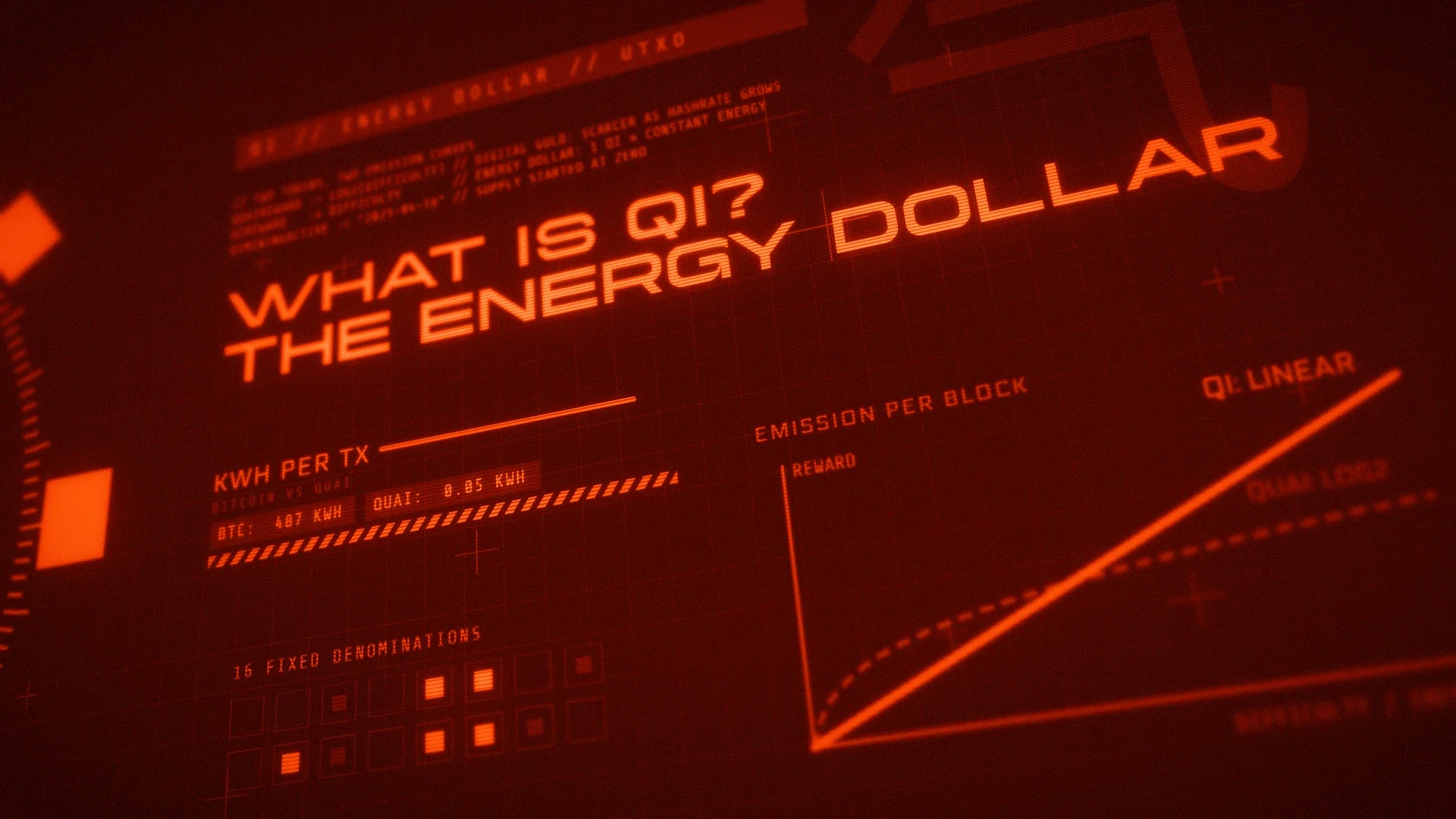
QI is the energy dollar of Quai Network: a digital cash currency whose supply is minted only by Proof-of-Work mining, in direct proportion to mining difficulty. Because difficulty tracks the energy spent securing the network, each QI is designed to represent a constant amount of energy, so its value is anchored to the cost of energy rather than to a government's promise.
The name comes from 气 (qi), the Chinese word for energy or life force. Here is why money for an age of machines should be measured in joules, not fiat.
The currency problem the AI economy creates
In late 2025, Elon Musk told an interviewer something that sounded like science fiction but was really just simple accounting: "Energy is the true currency."
His reasoning was that as artificial intelligence and robotics drive the marginal cost of goods and labor toward zero, money, which is fundamentally "a database for labor allocation," loses its grip on reality. What remains scarce, and what every computation and every robot ultimately consumes, is energy. "This is why I say Bitcoin is based on energy," he added, pointing at Proof-of-Work as the one monetary system already denominated in physical effort.
He is describing a world that is arriving on schedule. The International Energy Agency estimates that data centers consumed about 415 TWh of electricity in 2024, around 1.5% of global electricity use, and projects that demand will more than double to around 945 TWh by 2030, slightly more than Japan's total electricity consumption today.

Accelerated servers, mainly driven by AI adoption, are expected to grow at 30% a year, and in advanced economies data centers are expected to account for over 20% of all electricity demand growth through 2030. AI is, at the level of physics, a machine for turning electricity into intelligence.
The AI economy is becoming a country-scale electricity market, not just a software market.
That shift breaks an assumption built into every existing form of money. Fiat currencies are denominated in nothing; their value floats on central-bank policy and political trust. Crypto-assets like Bitcoin are volatile by design. And the stablecoins meant to fix that volatility are pegged to the very fiat currencies whose instability prompted the search for alternatives. None of them are denominated in the thing the machine economy actually spends.

QI, the energy dollar at the center of Quai Network's two-token system, is an attempt to build the money for this future economy: a currency whose value is anchored not to a government's promise but to the cost of energy itself.
An old idea, finally possible
The notion that money should be backed by energy rather than gold is not a crypto-native invention. It is more than a century old, and it came from the two most consequential industrialists in American history.
In December 1921, Henry Ford traveled to Muscle Shoals, Alabama, and used the pages of The New York Tribune to propose replacing the gold standard with what he called an "energy currency." His logic was that of an engineer, not a banker. The Muscle Shoals site held a river "capable of furnishing 1,000,000 horsepower." Ford asked which was "the more imperishable, the more secure" backing for currency: that perpetual power site, or "the several barrels of gold necessary to make $40,000,000"?
Under his system, "the standard would be a certain amount of energy exerted for one hour that would be equal to one dollar." Ford believed an energy standard could break the banking elite's control over the money supply and, by removing the financial leverage that funded conflicts, even help "put an end to wars."

His friend Thomas Edison backed the idea publicly the same week, arguing in The New York Times for a currency backed by physical commodities and productive capacity rather than gold. Both men had located the same insight: gold is valuable by convention, but energy is valuable by physics.
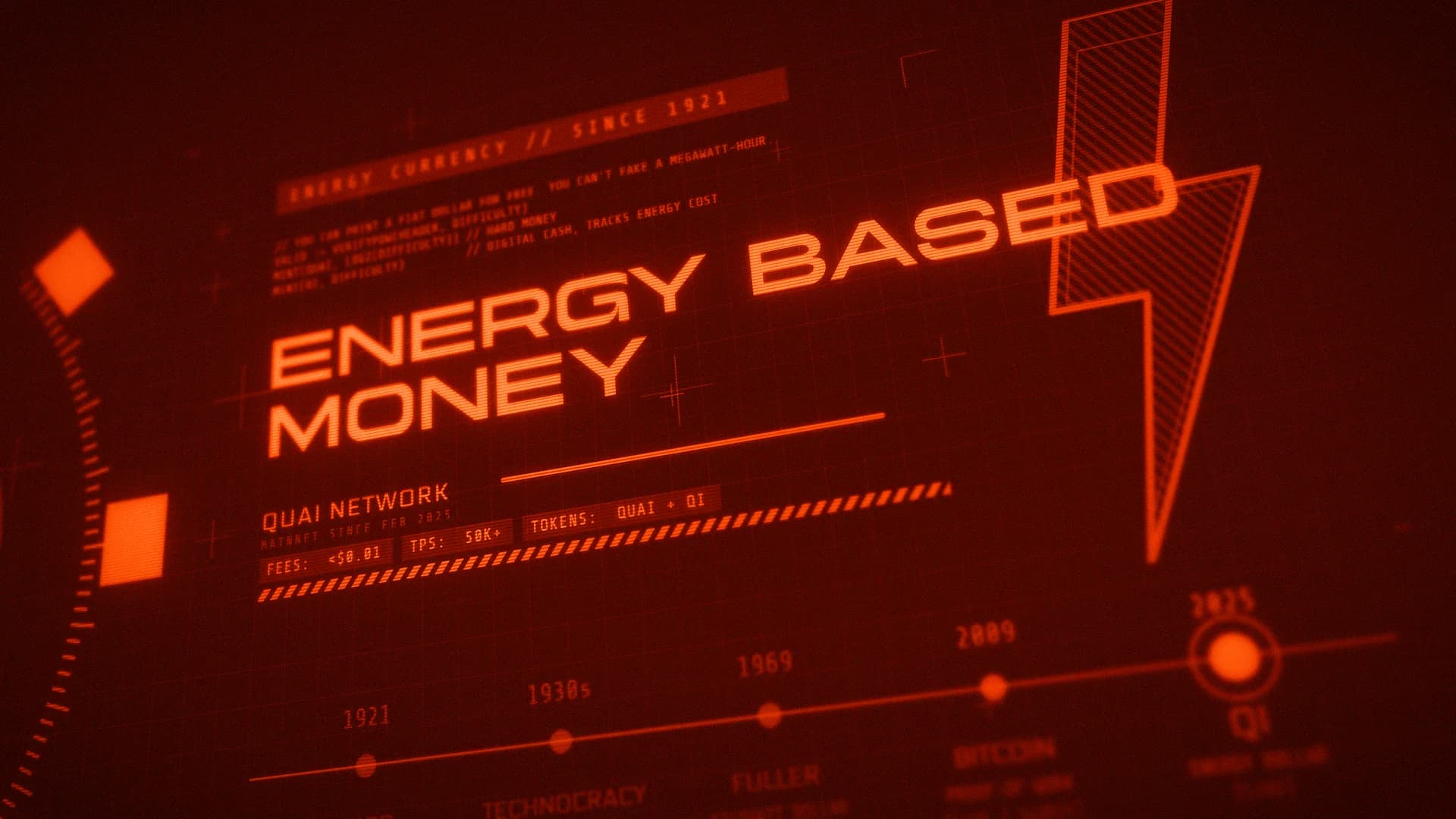
Half a century later, Buckminster Fuller gave the idea its most precise form. In his 1969 Operating Manual for Spaceship Earth, Fuller proposed a global currency denominated in the kilowatt-hour, what he called the "Kilowatt Dollar." Electricity, he reasoned, is universally necessary, universally measurable, and the same everywhere: it is "the universal denominator of work and value." A money backed by kilowatt-hours, rather than by trust in governments, would force economic accounting to tell the truth.
For a hundred years these proposals failed for the same boring reason. There was no way to issue and account for an energy-denominated currency without trusting some central authority to measure the energy, hold the reserves, and resist the temptation to cheat. Ford needed the U.S. government to print and manage his energy dollars. Fuller's kilowatt dollar required a global energy grid and a global institution to run it. The idea was sound; the trust model was impossible.
What changed is that Proof-of-Work blockchains turned energy expenditure into something objectively verifiable and trustlessly accountable. That is the missing piece Ford and Fuller never had, and it is exactly why QI cannot be built as a database, a bank product, or a fiat-pegged token. It needs a blockchain. For the wider history, see energy based money: what it is and how Quai built it.
The two-token design: separating store of value from medium of exchange
Money is asked to do two things that are in fundamental tension: hold its value over time (a store of value) and flow freely as a medium of exchange. A good store of value should be scarce and appreciating, which makes people reluctant to spend it: Gresham's law in action, the reason nobody buys coffee with Bitcoin. A good medium of exchange should be stable and abundant enough to transact in casually, which makes it a poor long-term savings vehicle. Most monetary systems pick one and compromise the other.
Quai Network's answer is to stop compromising and issue two native tokens, each optimized for one job:
| QUAI ("digital gold") | QI ("the energy dollar") | |
|---|---|---|
| Role | Store of value | Medium of exchange and unit of account |
| Emission | Logarithmic, increasingly scarce | Linear, tracks energy cost |
| Ledger model | Account-based, EVM-compatible | UTXO-based with Schnorr signatures |
| Privacy | Transparent | Cash-like privacy by default |
| Purpose | Smart contracts, DeFi, savings | Payments, settlement, pricing |
The names are deliberate. Quai (pronounced "k-why") comes from the Chinese 块, colloquial slang for money, like "buck" or "quid." Qi (pronounced "chee") comes from 气, meaning "energy" or "life force," reflecting its role as the world's first token whose value is intrinsically tied to the cost of energy production.
The emission math is the core of the design:
- QUAI block reward ∝ log₂(difficulty). For every doubling of mining difficulty (twice the energy spent securing the network), QUAI issuance rises by just one logarithmic unit. As the network grows, QUAI becomes progressively scarcer. It behaves like digital gold.
- QI block reward ∝ difficulty (linear). When difficulty doubles, QI issuance doubles too. Because difficulty is a direct proxy for total energy expenditure, each unit of QI represents a constant quantity of energy, no matter when it was mined.
The two-token system splits the jobs money usually confuses: QUAI absorbs scarcity; QI tracks the energy-cost base for payments and pricing.

That second property is the whole reason it works. QI is a flatcoin: designed to remain stable against thermodynamic cost rather than against an arbitrary fiat denomination. Because QI issuance scales linearly with mining difficulty, the direct measure of energy expended, each unit of QI is meant to embody a constant quantity of energy. Its purchasing power is therefore designed to track the cost of energy itself. See the tokenomics overview for the full model.
Proof-of-Work as a physical oracle
The hardest problem in connecting a blockchain to the real world is the oracle problem: how does on-chain code learn a real-world price without trusting some off-chain reporter who can lie, be bribed, or go offline? Most algorithmic stablecoins that tried to track external value this way have collapsed, Terra/Luna being the most spectacular.
QI sidesteps the oracle problem by recognizing that Proof-of-Work mining already produces an endogenous signal for the cost of energy. Miners are rational businesses; they will only spend a joule of electricity to mine a block if the expected reward justifies that joule after hardware efficiency, fees, token price, and operational costs. Mining difficulty therefore continuously reflects the competitive boundary between marginal reward and marginal cost. No reporter, no DAO vote, no price feed, just the revealed economics of competitive mining. Proof-of-Work functions as a physical cost signal, reflecting energy constraints without direct exposure to energy industry operations.
This is also why energy expenditure is the only known objectively verifiable mechanism to link the security and scarcity of a currency to the constraints of the physical world. You can fork the software, fake a signature, or print a fiat dollar at zero marginal cost. You cannot fake having burned a megawatt-hour. The energy is the proof.
Privacy: money should behave like cash
A medium of exchange has a requirement a store of value does not: it must be private. When you pay for coffee with a $20 bill, the barista doesn't learn your salary, your address, or every other purchase you've ever made. Digital payments destroy that property, and in a world of machine-speed transactions, surveillance scales accordingly.
QI is built to restore cash-like privacy, and it does so structurally rather than through bolt-on cryptography. Quai's two tokens deliberately use different ledger models for this reason: QUAI uses a transparent, account-based ledger (the right tradeoff for auditable smart contracts), while QI uses a UTXO ledger (like Bitcoin's) engineered for privacy and parallelism. QI's privacy rests on four design choices:
- Enforced non-address-reuse: the protocol requires every payment to go to a fresh, unique address, so observers can't cluster your activity by watching one address.
- Payment codes (BIP-47): a sender derives a unique address for each transaction while the recipient publishes just one reusable identifier.
- Fixed denominations: QI exists in only 16 fixed denominations (versus Bitcoin's 100 million satoshis per coin), so every transaction looks structurally similar, like a default two-party CoinJoin.
- Incentivized cooperative re-aggregation: the rules nudge users to consolidate UTXOs cooperatively, blending transaction graphs.
QI aims for transparency without traceability: anyone can verify the ledger's integrity, while the protocol is designed to make tracing who paid whom structurally harder. A truly global, decentralized economy must protect privacy by design, not as an afterthought.
This matters more, not less, as money goes digital. Over 130 countries are now developing central bank digital currencies, which give issuers direct visibility into, and programmable control over, every transaction: spending limits, expiry dates, and account freezes without due process. Meanwhile, centralized stablecoins like USDC and USDT depend on banking relationships regulators can sever, and have frozen funds at government direction. A stablecoin that can be frozen is not stable; it is a permission slip.
Permissionless, energy-backed money exists outside those systems by design.
Why this has to be a blockchain
It is fair to ask: if QI tracks energy cost, why not just have a company issue an energy-indexed token, or a central bank run an energy-pegged CBDC? This is precisely where Ford's and Fuller's century-old proposals died, and where the blockchain is not decoration but the entire point.
A blockchain is required because QI needs four properties at once that no centralized issuer can provide together:
- Trustless measurement of energy. The energy backing must be real and impossible to fake. Only competitive Proof-of-Work mining produces an objectively verifiable record of energy expended. A central issuer claiming "this token is backed by energy" is back to trusting an auditor, the same failure mode as fiat reserves.
- No central point of control or seizure. The whole value proposition is opting out of permissioned money. A token a company can freeze, or a CBDC a government can program, is not the energy dollar Ford imagined; it's a more efficient leash.
- An oracle that can't be corrupted. The energy price must enter the system without a trusted reporter. Mining difficulty is that oracle, generated by the same decentralized process that secures the chain.
- Censorship-resistant settlement. Machines and humans across borders must be able to transact without a gatekeeper approving each payment.
Strip away the blockchain and you lose all four. This is the same reason Bitcoin had to be a blockchain rather than a PayPal feature. QI extends that logic from digital scarcity to digital energy money.
The scalability barrier energy money had to clear
Proof-of-Work could secure energy money, but one barrier remained. Bitcoin's single-chain design caps throughput at roughly 5 to 7 transactions per second, and each transaction embodies on the order of 487 kWh of energy, enough to power a typical home for about two weeks. No machine economy of millions of micropayments per second can run on that foundation.
Quai's architecture breaks the ceiling while preserving Proof-of-Work:
- Proof-of-Entropy-Minima (PoEM), Quai's consensus rule, measures the intrinsic entropy each block removes rather than treating all valid blocks as equal. Every node instantly prefers the same block, eliminating temporary forks and improving Proof-of-Work finality.
- Merged mining across a hierarchy of chains (a Prime chain, Region chains, and many Zone chains) lets a single miner secure multiple chains with one computation.
- Horizontal sharding with segmented state lets each Zone process transactions in parallel while every transaction still inherits 100% of the network's hash security. Each node stores only a fraction of global state, keeping participation accessible.
Any monetary system for machine-speed commerce has to clear these thresholds, and Quai's protocol documentation says it can:

A Bitcoin transaction at about 487 kWh embodies two weeks of household power. A Quai transaction at about 0.05 kWh charges a phone twice. Same energy-backed security model, four orders of magnitude more useful output per joule.
Why an AI economy specifically wants energy money
Put the pieces together and a striking fit emerges between QI's design and the needs of an economy run increasingly by software agents.

Energy is the AI economy's primary input. Every inference, every training run, every robot's motion is fundamentally electricity consumed. A currency denominated in energy is denominated in the one cost AI cannot escape, making QI the natural unit of account for pricing compute, models, and machine services. Just as a kilowatt-hour means the same thing in Texas, Tokyo, or orbit, QI is a universal unit of value with no currency-conversion risk.
Machines need a stable unit, not a speculative one. Autonomous agents are now transacting in earnest: Mastercard announced Agent Pay in April 2025, and Circle's Nanopayments product advertises gas-free, high-frequency agentic transactions as small as $0.000001 with instant verification. An agent cannot reason about value if its unit of account swings 10% a day. It requires stability, divisibility, near-zero cost, and finality in seconds. These are the requirements QI is built to satisfy.
Proof-of-Work turns AI's energy appetite into monetary security. AI's explosive, often geographically lumpy energy demand is usually framed as a problem: strained grids, stranded renewable capacity, curtailed solar and wind. Proof-of-Work mining is uniquely able to act as a buyer of last resort for surplus and stranded energy, soaking up excess capacity, improving the economics of renewable buildout, and converting otherwise-wasted electricity into monetary security. The same energy that powers the machines can mint the money the machines use.
Conclusion: money that tells the truth
Henry Ford and Buckminster Fuller identified the destination. Proof-of-Work supplied the missing mechanism: a trustless, decentralized, physically grounded signal for the cost of energy. Quai built the complete monetary system around it: linear emission designed to hold QI near energy cost, a conversion controller that disciplines price through miner choice, cash-like privacy for the medium of exchange, and a sharded architecture designed to be fast and cheap enough for machine-speed commerce.
Energy is the true currency of the AI age. QI is built for this moment.
QI FAQ
What does QI mean in money?
In Quai Network, QI is the name of the network's energy dollar: a cryptocurrency for everyday payments whose supply is tied to the energy spent on mining. The name comes from 气 (qi), the Chinese word for energy or life force.
Is QI a stablecoin?
Not in the usual sense. QI is not pegged to the U.S. dollar and has no bank reserves behind it. It is a flatcoin, designed to hold steady against the cost of energy instead. Its price in dollars can still move. Read A New Era of Stablecoin: QI the Energy Dollar.
How is QI different from QUAI?
QUAI is the scarce store of value, used for savings, smart contracts and DeFi, and its issuance grows only logarithmically with mining difficulty. QI is the spending currency, with issuance that grows linearly with difficulty so it tracks the cost of energy. The protocol converts between them at market rate.
When did QI launch?
QI mining activated on April 16, 2025, starting from a supply of zero.
How do I get QI?
You can mine it by setting your miner's reward preference to QI, convert QUAI to QI with the Market Make feature in the Pelagus wallet, or swap for wrapped QI (WQI) on Quainance. More answers are in the Quai Network FAQ.
This article is for information only and is not financial advice.