Energy Based Money: Quai Network's Vision for the 21st Century
Energy based money is money tied to the real energy spent to create it. See how Quai Network's QUAI and QI tokens turn Proof-of-Work into money.
"I think the future currency will essentially just be wattage." Elon Musk, Moonshots podcast with Peter Diamandis, January 2026
Elon Musk has been saying it for months. At Tesla's 2025 annual shareholder meeting: "Maybe there won't even be money in the future. Or money might be measured in terms of wattage." On the People by WTF podcast: "Energy is the true currency. You can't legislate energy."
He's describing energy based money: money whose supply is tied to the real energy spent to produce it, so no one can create more of it for free.
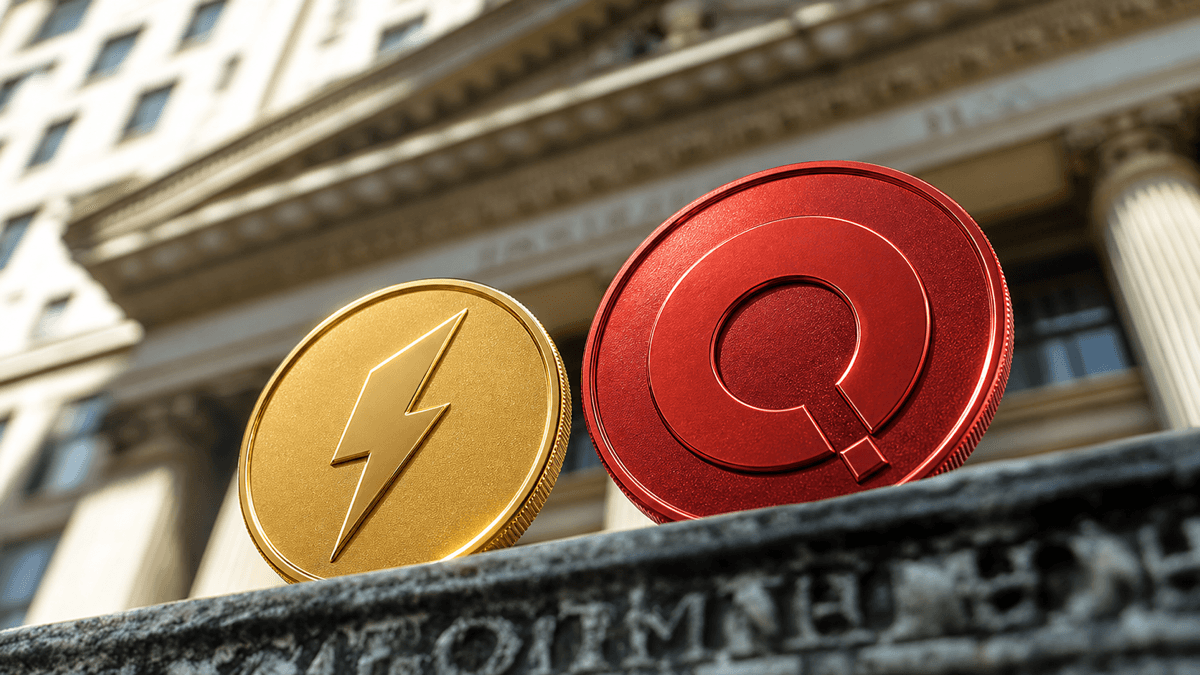
Quai Network was built on that idea. It's a Proof-of-Work blockchain with two native tokens: $QUAI, scarce hard money, and $QI, digital cash designed to track the cost of energy. It has been live on mainnet since February 2025.
The names are deliberate. Quai comes from the Chinese 块, slang for money, like "buck." Qi comes from 气, meaning energy or life force.
Why energy based money?
The idea is older than crypto. In 1921, Henry Ford proposed replacing the gold standard with an "energy currency," where "a certain amount of energy exerted for one hour" would equal one dollar. Thomas Edison backed him the same week. In 1969, Buckminster Fuller proposed the "Kilowatt Dollar," a global currency measured in kilowatt-hours.
The logic is simple. Gold is valuable by convention; energy is valuable by physics. Every product, every service and every computation costs energy. Money tied to energy is tied to the one thing every economy runs on.
Every one of those proposals failed for the same reason: someone had to be trusted to measure the energy, hold the reserves and resist the temptation to cheat.
Proof-of-Work removed that trust. Mining turns electricity into a record that anyone can verify, with no central authority. You can print a fiat dollar for free. You can't fake having spent a megawatt-hour.
That matters more every year. AI is turning electricity into the scarcest input in the economy. The International Energy Agency projects data center electricity use will more than double by 2030. An economy that runs on energy needs money that speaks in energy.
Energy based money vs gold, fiat and stablecoins
The point of money is to be a high-fidelity signal: an abstract reference that lets people trade efficiently. Every time that signal is polluted, by politics, by printing, by handing new money to favored groups, it turns into noise. That's how you get an economy where some people are paid enormously for creating little value while the people growing our food barely get by.
Energy is the cleanest signal available. It's the underlying unit of the economy, and of human wellbeing too: quality of life and energy use rise together almost everywhere. Using energy as the unit of account ties money back to what people actually produce and consume.
It's also the most widely available and least controlled resource on Earth. Gold and diamonds sit in a few places, can be controlled by whoever holds the land, and can be confiscated. Energy can be produced almost anywhere: with solar panels, with a generator, even with a bicycle or waste heat.
| Gold | Fiat (dollar, euro) | Stablecoins (USDT, USDC) | Energy based money (QUAI, QI) | |
|---|---|---|---|---|
| Backed by | Mining effort and convention | Government promise | Bank deposits and treasuries | Energy spent on Proof-of-Work |
| Who controls new supply | Mining companies, geography | Central banks | The issuing company | Open mining, set by protocol rules |
| Who can produce it | Whoever owns the mines | No one but the issuer | No one but the issuer | Anyone with hardware and electricity |
| Can it be frozen or seized? | Yes, it's physical | Yes, through banks | Yes, issuers freeze funds | No central party can freeze it |
| Inflation | Low | Set by policy, often high | Follows the pegged currency | QUAI decreasing; QI tracks energy cost |
| Everyday payments | Impractical | Yes | Yes | Yes, fees under a cent |
| Verifiable by anyone | Needs audits | No | Needs audits | Yes, on-chain |
The problems Quai solves
- Scalability vs security. Most blockchains trade one for the other. Quai scales Proof-of-Work across many chains that share one security layer.
- Money tied to something real. Stablecoins are pegged to fiat currencies. Quai ties its money to the energy spent to create it.
- The limits of Proof-of-Stake. Staking systems tend to concentrate power with the largest holders. Quai stays Proof-of-Work, open to anyone with hardware and electricity.
- The spend-or-save problem. Good savings money is scarce, so people don't spend it. Good spending money is stable, so it's a poor store of value. Quai issues one token for each job.
How it works
Two tokens, one standard
$QUAI
- Role
- Hard money
- Issuance
- Logarithmic with difficulty
- Used for
- Savings, smart contracts, DeFi
Its issuance grows only logarithmically with mining difficulty, so it gets scarcer as the network grows.
$QI
- Role
- Digital cash
- Issuance
- Linear with difficulty
- Used for
- Everyday payments
Its issuance grows linearly with mining difficulty, so each QI is designed to represent a constant amount of energy. It has cash-like privacy.
The protocol converts between the two at market rate, with no intermediary.
Proof-of-Entropy-Minima (PoEM)
Quai's consensus weighs each block by the work behind it, so every node instantly agrees on the same chain. That means no long reorganizations and faster finality, while keeping Proof-of-Work security.

One hash secures many chains
Quai is built as a hierarchy: a Prime chain, Region chains and Zone chains, all merge-mined together. One unit of mining work secures every chain at once, so adding chains adds capacity without splitting security. Peak capacity is 255,000+ transactions per second, with fees under a cent.

EVM-compatible
Developers can deploy Solidity smart contracts with familiar tools like Hardhat, Foundry and ethers.js.
Dynamic sharding
Quai adds execution shards as demand grows, based on signals like the uncle block rate and the gas limit. Capacity expands with use instead of being fixed at launch.
Structured subnets
Nodes organize into subnets that match the chain hierarchy, so blocks and transactions travel shorter paths. That cuts broadcast delay and latency as the network grows.
Workshares
Mining attempts that come close to a valid block, but don't quite make it, are counted as workshares. They add to the network's security and pay the miners who produced them, which keeps rewards steady for small miners.
What makes Quai different
- Work-based consensus. Blocks are weighted by the actual computational work behind them, so the honest chain always wins without long waits.
- Parallel processing. Many chains process transactions at the same time, under one shared security layer.
- Hash-linked issuance. QI issuance is tied to mining difficulty, which reflects the real cost of energy. Money supply follows physics, not policy.
- Built for everyday use. Fees under a cent, fast finality and EVM programmability make it practical for payments and apps, not just storage.
- Energy-backed scarcity. QUAI gets scarcer as the network grows, and SOAP burns QUAI bought with rewards from other chains.
Why miners care
- Use the hardware you already have. Quai can be mined with SHA-256 machines (like a Bitaxe), Scrypt machines, and GPUs through KawPoW.
- Get paid for the work you do. Workshares reward the work a miner contributes, not only full blocks, so small and home miners earn steadily instead of waiting for a lucky block.
- Mine more than one chain at once. Through merge-mining, Quai miners also secure Litecoin, Bitcoin Cash, Dogecoin and Ravencoin.
- Solo mining made simple. StratumX lets miners mine Quai with no node, no KYC and no fees.
- Choose your reward. Miners decide whether to take rewards in QUAI or QI, which helps keep the two tokens in balance.
Why developers care
- Parallel execution across many chains, so one busy app doesn't slow down the network
- Familiar EVM tooling and Solidity
- Proof-of-Work decentralization without the validator concentration common in staking networks
- A native energy-based unit of account (QI) for pricing apps and services
What's new since launch
SOAP: other chains' rewards buy and burn QUAI
Under SOAP (the Subsidized Open-market Acquisition Protocol), the rewards Quai miners earn by merge-mining Litecoin, Bitcoin Cash, Dogecoin and Ravencoin go to the protocol. Those rewards are used to buy $QUAI on the open market, and 100% of what's bought is burned.

More hashrate means more buying and less QUAI in existence. Track it live at soap.qu.ai.
Singularity: the first genesis burn
The Singularity fork went live in March 2026, at Prime block 1,530,500. Investors, Dominant Strategies and the Quai Foundation agreed to give up their future vested unlocks, and about 1.67 billion QUAI was removed from the genesis allocation.
That eliminated 81.1% of future genesis unlocks. The emission schedule now skips those addresses at the protocol level, so the tokens can never enter circulation.
Singularity also made Quai's supply model simple to read:
Total supply = genesis unlocks + mining emissions − SOAP burns
As SOAP burns grow, net emissions are designed to trend toward zero. The same upgrade added limits on workshares per block, balanced between SHA-256 and Scrypt miners. Read the Singularity announcement.
Polaris: harder money, faster
The Polaris fork, together with the earlier Singularity fork, burns 1.9 billion of the original genesis QUAI. The founders and the Dominant Strategies team are permanently burning 236,456,538 of their own future unlocks.
What Polaris changes:
- Genesis inflation: 13% to under 4%
- Total inflation: 18% to under 9%
- Circulating supply: 77% to 93% of all QUAI
- Monthly genesis unlocks: about 13M to about 3.7M QUAI
- Genesis QUAI left to unlock: 327M to 90M, fully unlocked by early 2029
At the same age, year 3, QUAI's inflation is 8.3%. Bitcoin's was 59%, Litecoin's 49.4%, Monero's 23.7% and Kaspa's 17%. Read the full Polaris breakdown.
Get involved
- Mine: point a SHA-256, Scrypt or KawPoW miner at StratumX.
- Hold and use: get a wallet like Pelagus or BlipPay at qu.ai/wallets.
- Build: start with the Quai docs and the Builder Grants program.
- Join the community on X and Discord, and at Quai Friday every week.
Glossary
- Energy based money: money whose supply is tied to the real energy spent to produce it.
- QUAI: Quai Network's scarce store-of-value token, with issuance that grows logarithmically with mining difficulty.
- QI: Quai Network's energy dollar, digital cash whose issuance grows linearly with mining difficulty.
- Proof-of-Work (PoW): a system where miners spend real computing energy to add blocks and secure the network.
- PoEM (Proof-of-Entropy-Minima): Quai's consensus rule, which weighs blocks by the work behind them for instant agreement.
- SOAP: the Subsidized Open-market Acquisition Protocol, which uses merge-mining rewards to buy and burn QUAI.
- UTXO: a ledger model where coins are tracked as individual unspent outputs, used by QI for privacy.
- EVM: the Ethereum Virtual Machine; Quai supports its smart contracts and tools.
FAQ
What is energy based money?
Energy based money is money whose supply is tied to the real energy spent to produce it, so no one can create more of it for free. Proof-of-Work cryptocurrencies are the working example: new coins can only be created by spending energy on mining.
Did Elon Musk say energy is the new currency?
Yes. He has said money "might be measured in terms of wattage," that "energy is the true currency," and that "the future currency will essentially just be wattage."
What is QI, the energy dollar?
QI is Quai Network's digital cash. Its issuance grows in step with mining difficulty, so each QI is designed to represent a constant amount of energy, with cash-like privacy for payments.
How is QUAI different from QI?
QUAI is the scarce store of value, used for savings and smart contracts. QI is the spending currency, designed to track the cost of energy. The protocol converts between them at market rate.
Is Bitcoin energy based money?
In one sense, yes: new bitcoin can only be created by spending energy. Quai builds on the same idea, adding a second token for everyday payments and scaling Proof-of-Work to far more transactions.
How do I get energy based money?
You can mine it with SHA-256, Scrypt or KawPoW hardware through StratumX, or get QUAI on exchanges like Kraken. See qu.ai/how-to-get-quai.
This article is for information only and is not financial advice.