The Case for an Energy Dollar
Why money should be tied to energy production: how an energy dollar on Proof-of-Work could fix inflation, track real value and fit the age of AI.

Fixing the global monetary system, escaping societal collapse, and accelerating into techno-utopia. Originally published on the Quai blog in August 2024.
"If you want to find the secrets of the universe, think in terms of energy, frequency and vibration." Nikola Tesla
TL;DR:
- The Energy Dollar proposes tying currency directly to energy production, creating a thermoeconomic monetary system that is governed by physics.
- This concept aligns economic incentives with technological progress and energy efficiency.
- The Energy Dollar could run on a blockchain system and be interoperable with the emerging techno-economic landscape in the age of AI.
Introduction
In the grand tapestry of human progress, energy stands as the golden thread weaving through every advancement. From the first spark of fire to the hum of nuclear reactors, our mastery over energy has defined the trajectory of civilization. As we stand on the precipice of a new era, it is time to reassess the very foundation of our economic systems. In this article I'll attempt to form the foundations for a radical yet intuitive concept: the Energy Dollar, a currency intrinsically linked to energy production.
The need for such a fundamental rethinking of our monetary system has never been more urgent.
Following record inflation, we now face a potential financial crisis dwarfing previous downturns. The Treasury market has exploded to $27 trillion, up 60% since the pandemic and sixfold since 2008. Federal debt is growing by $1 trillion quarterly, with government spending as a percentage of GDP at World War II levels. This debt, borrowed at around 5%, is propping up the economy. The treatment of Treasuries as cash equivalents means any instability could trigger a catastrophic domino effect in the global financial system, potentially forcing extreme government interventions with unpredictable consequences.
In this context, let's explore the Energy Dollar as a potential solution. By directly tying our monetary system to energy production, we could create a more stable, transparent, and growth-oriented economic environment.
An energy-based currency would:
- Provide a more stable unit of account, resistant to the kind of monetary policy that has led to negative interest rates and inflated asset bubbles.
- Offer a more accurate measure of economic activity and value creation.
- Create a natural check against inflationary policies by tying currency directly to real energy expenditure.
- Enhance the information content of prices, leading to more efficient resource allocation.
The system has gotten to a point of rapid instability. Rethinking the very nature of our money is a necessity for our continued prosperity and stability.
The Energy Dollar concept
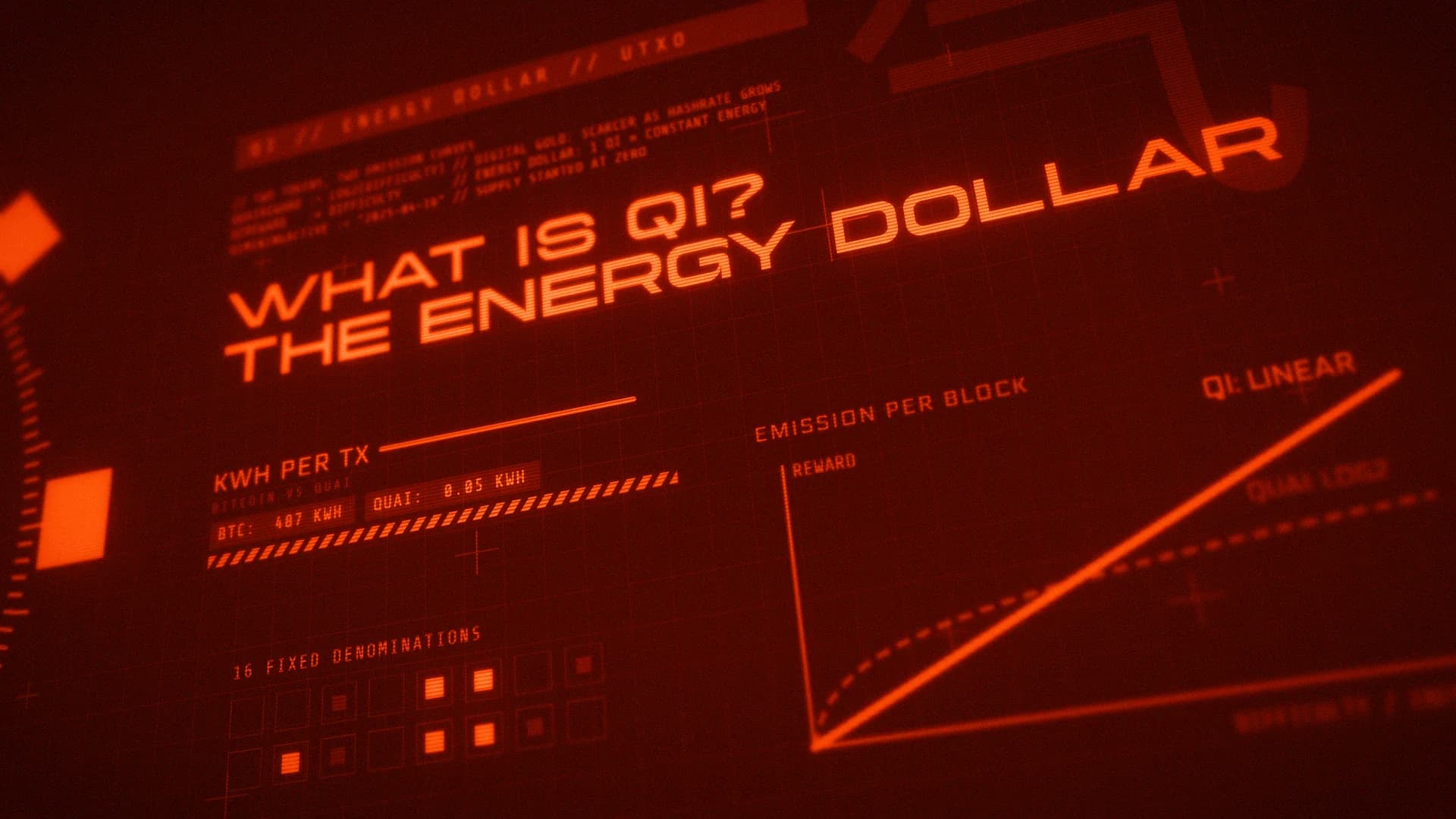
The Energy Dollar system is a revolutionary approach to currency by directly tying monetary value to energy production. Unlike traditional currencies, Energy Dollars would fluctuate based on global average energy prices across diverse sources, ensuring the currency remains a true representation of the current energy market.
Compared to gold-backed currencies, the Energy Dollar offers greater flexibility and relevance to economic productivity. Unlike fiat currencies, it would be backed by tangible energy production, naturally resistant to inflation, globally applicable, and transparent in its circulation.
An Energy Dollar could be implemented in a blockchain system like the following:

Blockchain could provide decentralized verification of energy production, manage currency issuance through a global network of nodes, and ensure transparency through public auditing. Its borderless nature aligns with the global applicability of an energy-based currency. With the properties of Proof-of-Work, anyone would be able to contribute resources in order to secure the blockchain and create the Energy Dollar.
This Energy Dollar concept presents a currency system that is more stable, transparent, and aligned with humanity's technological progress than current options. By directly linking currency to energy, the common reference point for all goods and services, the Energy Dollar would align economic incentives with the thermodynamics of production.
An energy currency would rely on supply and demand dynamics, a cornerstone of capitalism. This approach aligns with ideas that seek to optimize long-term rates of increasing prosperity through core tenets of capitalism and natural selection within the fundamental laws of thermodynamics.
The nature of energy as currency
The ability for mankind to harness energy is the greatest enabler of economic growth and prosperity. Historically, our money has approximated energy through commodities up until the point of fiat.
Commodity money, such as gold, has historically been an effective form of currency, primarily because its production requires significant energy inputs, tying its value to real-world resources. The scarcity of many commodities, like energy, helps maintain their value. However, commodity money is not without drawbacks. Many commodities have industrial or decorative uses, creating secondary markets that can distort their value as currency. The ideal form of money would represent energy inputs but lack a significant secondary market. Gold has historically excelled in this regard, as it requires substantial energy for mining and refining, reflecting real-world value, while having relatively few industrial applications that could distort its monetary value.
Fiat currency further distorts the ability for money to accurately represent economic output since it can be printed freely at will. Since the United States moved off of the gold standard in the early 1970s, energy has only gotten more expensive in dollar terms and consumers' access to energy has completely flatlined.

When looking at energy compared to the Canadian dollar, a historically stable trading pair to the U.S. dollar, energy has lower volatility. The relative stability of energy prices shows that an energy-based currency offers a more consistent reference point than a single fiat currency.

The comparison with the Canadian dollar highlights a fundamental issue in our current monetary system: central banks often struggle to implement effective monetary policy. Their human-driven decisions can be influenced by political pressures, short-term thinking, or misinterpretation of complex economic data, leading to suboptimal outcomes. In contrast, physics offers a more robust framework for determining the size and behavior of the monetary supply. Unlike human decision-makers who may act in their own interests, potentially undermining the very people they're meant to serve, the laws of thermodynamics are universal, impartial, and devoid of self-interest. They simply exist as fundamental properties of our universe.
Challenges and criticisms
While the idea of an energy-based currency is intriguing, it's essential to recognize why energy itself would be a poor form of money despite its fundamental economic role. Dispatchable energy, or energy available on demand, is geographically constrained and temporally bound, making it highly localized and challenging to store efficiently over the long term. Moreover, energy does not constitute a large enough portion of the economy to serve as a viable currency basis. Good money doesn't need to be convertible back into the input energy it represents; rather, it should be storable, transportable, durable, divisible, and fungible, criteria that energy itself fails to meet. However, a well-designed Energy Dollar could embody these characteristics while still reflecting the value of underlying energy, capturing the benefits of energy as an economic driver without the practical limitations of using energy directly as a medium of exchange.
The inflationary nature of the proposed Energy Dollar system bears some resemblance to current fiat currency systems, such as the U.S. dollar, which typically target a low, stable inflation rate (often around 2% annually). In the case of the Energy Dollar, the inflation rate would be determined by advancements in energy production efficiency rather than being arbitrarily set by a central bank. This natural, technology-driven inflation could serve a similar economic function to the targeted inflation in current systems, encouraging the circulation of money and discouraging excessive hoarding.
However, it's important to note that, much like in our current economic system, the Energy Dollar wouldn't need to serve all functions of money equally. While it could excel as a medium of exchange and unit of account, tied closely to real economic activity and technological progress, other assets could naturally emerge or continue to serve as stores of value. Just as people today often use real estate, stocks, bonds, or cryptocurrencies as inflation hedges and long-term stores of value, similar or new alternatives could coexist with the Energy Dollar. This division of monetary functions could actually be beneficial, allowing the Energy Dollar to optimize for facilitating transactions and reflecting technological progress, while other assets handle long-term savings.
Energizing the future
The Energy Dollar represents more than just a novel economic concept. It embodies a paradigm shift in how we perceive and value human progress. By directly linking our monetary system to energy production, we create a currency that inherently promotes technological advancement, energy efficiency, and long-term growth. As we face unprecedented global challenges, the Energy Dollar offers a compelling path forward. It aligns our economic incentives with the fundamental drivers of human prosperity, potentially ushering in an era of unprecedented innovation.
The Energy Dollar is not just a currency; it's a beacon guiding us towards a more rational, sustainable, and prosperous future for all of humanity.
Where the Energy Dollar stands today
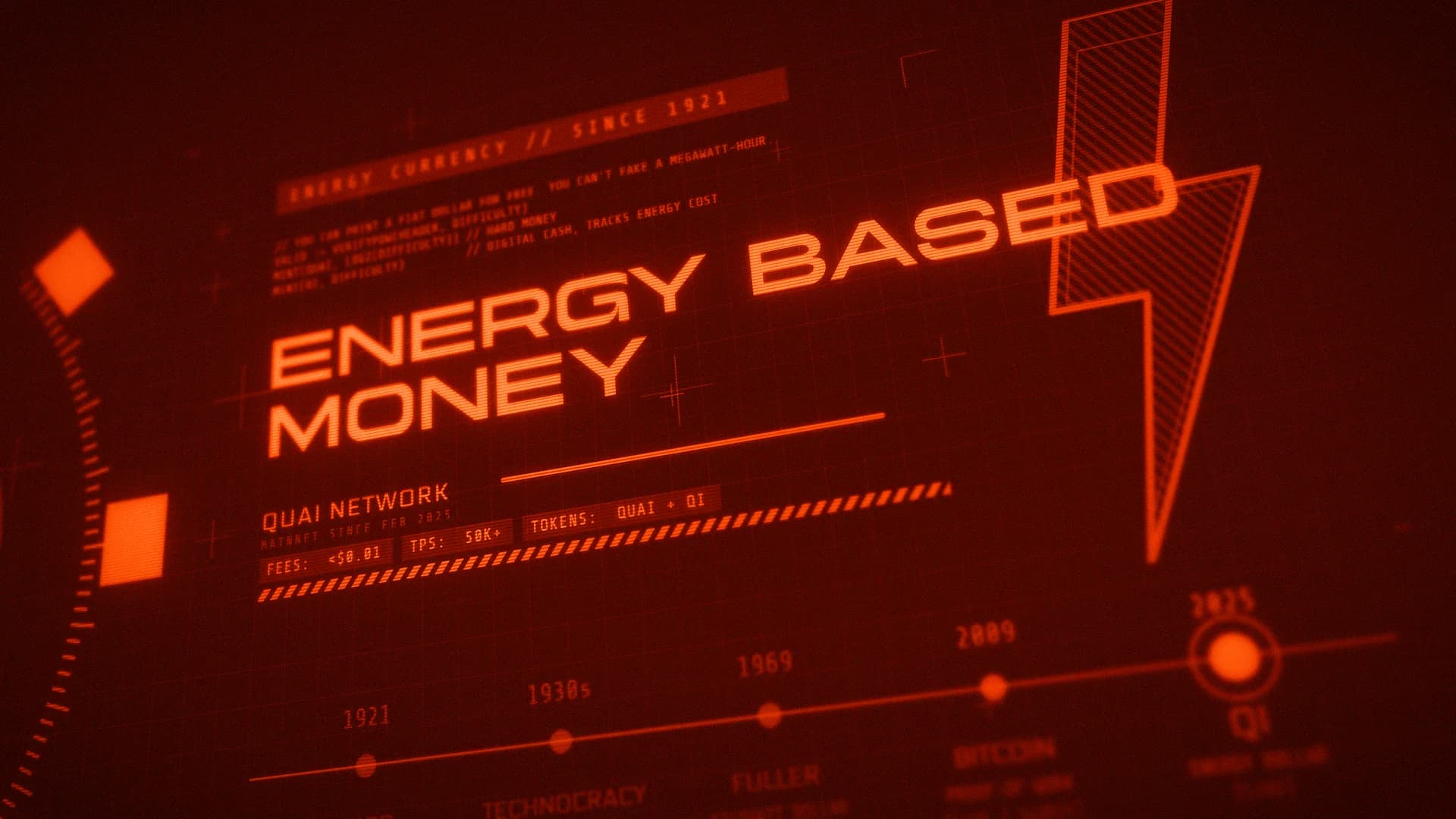
Since this essay was written, the idea went live. QI, Quai Network's energy dollar, activated on mainnet in April 2025, minted by Proof-of-Work in proportion to mining difficulty. And as this essay suggested, it splits the jobs of money: QI is built for spending, while QUAI serves as the scarce store of value.