Project SOAP Launches on Quai Network: Turning Merge-Mining Into Continuous QUAI Buybacks
Discover how this upgrade enables SHA-256 and Scrypt mining and turns external merge-mining subsidies into direct QUAI buybacks.
Quai Network is excited to announce the launch of Project SOAP (Subsidized Open-market Acquisition Protocol), a protocol upgrade that transforms traditional merge-mining into a revenue engine for Quai while opening new QUAI mining opportunities for SHA-256 and Scrypt miners.
SOAP is now live on Quai Network, marking a historic milestone for innovation in Proof-of-Work currencies. With it, Quai Network becomes the first blockchain to be mineable by SHA-256, Scrypt, and KawPoW algorithms simultaneously.
What SOAP Is and Why It Matters
Merge-mining has existed for over a decade. Historically, it allowed miners to secure two chains at once and receive rewards from both. But there’s a catch, when miners receive the auxiliary (child-chain) token reward, they often sell it immediately. That creates persistent selling pressure on the child chain.
SOAP flips this dynamic.
Instead of routing auxiliary chain subsidies to miners, SOAP routes 100% of the parent chain coinbase output to QUAI token buybacks. The purchased QUAI is then burned or distributed through time-locked staking rewards. Either way, SOAP turns external mining subsidies into permanent protocol support and continuous buy pressure for QUAI.
Bottom line: SOAP converts what used to be passive merge-mining security into an ongoing protocol revenue stream.
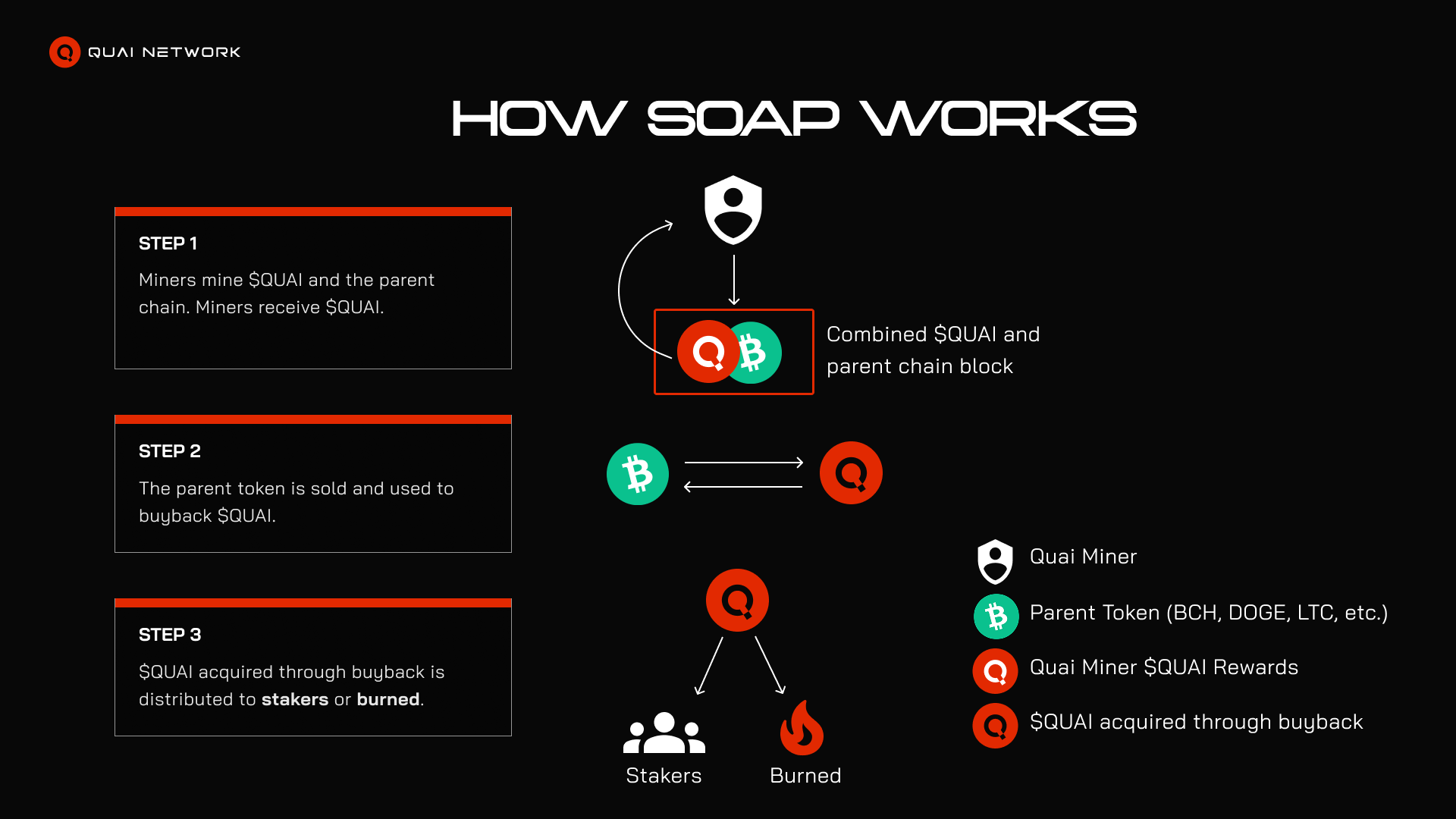
The Big Highlights
A New, Sustainable Revenue Source for Quai
SOAP creates a direct, recurring inflow to the protocol by converting external block subsidies into QUAI buybacks.
That means:
- daily buy pressure funded by other chains,
- a mechanism that can scale as more miners join, and
- a subsidy-backed economic flywheel that strengthens Quai over time.
Even in the “worst case” where all miners sell QUAI immediately, SOAP buybacks neutralize that sell pressure. In more realistic markets, where some miners and holders are long-term aligned, SOAP can result in net positive buy flow.
SHA-256 and Scrypt Miners Can Now Earn QUAI
SOAP expands Quai’s mining surface beyond KawPow block producers to SHA-256 (e.g., Bitcoin Cash hardware) and Scrypt miners (e.g., Litecoin/Dogecoin hardware).
ASIC miners can now submit SOAP-enabled workshares to earn QUAI rewards without abandoning their current ecosystems. You simply point the rigs at SOAP-enabled pools and continue mining as usual, while contributing valid AuxPoW commitments to Quai and getting paid in QUAI.
This introduces entire new mining communities to Quai and unlocks a path for ASIC-based ecosystems to economically align with Quai’s success.
what this brings for quai and miners
Project SOAP pushes Quai Network toward becoming the most economically resilient and hashrate-diverse PoW network in crypto.
With the protocol now live, Quai gains a continuous revenue flow for buybacks funded by external chains and avoids the traditional mining sell pressure. The expanded miner onboarding from SHA-256 and Scrypt ecosystems also further enhances the security of the chain with multi-algorithm consensus weighting.
With it, Quai miners benefit from a new QUAI revenue stream for their existing rigs, diversification across chains without splitting hashpower, and directly economically align with Quai’s growth.
Getting Started
The addition of SHA-256 and Scrypt mining will make Quai the most profitable token to mine for a period of time until the difficulty settles out. Being early is the best way to get the most QUAI yield. To track profitability, refer to Hashrate.no and WhatToMine.
If you’re interested in joining SOAP mining, refer to the guide in the Quai documentation to get started. The guide also contains the links for SOAP-enabled pools, including as Kryptex, K1Pool, HeroMiners, AlphaMine, and others. If you choose not to use a pool, you can point the hardware at your own node and start earning immediately through workshare rewards.
Mining pool operators can enable SOAP immediately through QuaI’s AuxPoW templates and standard Stratum v1 flows, no firmware changes required.
Reach out to us in Discord if you need any help. For more information on Project SOAP, refer to SOAP documentation.
The revolution is here. Miners, it’s time to power on.