Built Like a Commodity. Quai and the CLARITY Act
The CLARITY Act could expand U.S. access to digital commodities. Why Quai's energy based money, QUAI and QI, fits a commodity framework.
Congress is closer than ever to deciding where the line between securities and digital commodities sits. The Digital Asset Market Clarity Act is the most significant U.S. crypto market structure proposal to address that question, and Quai Network already publishes the facts the framework considers.
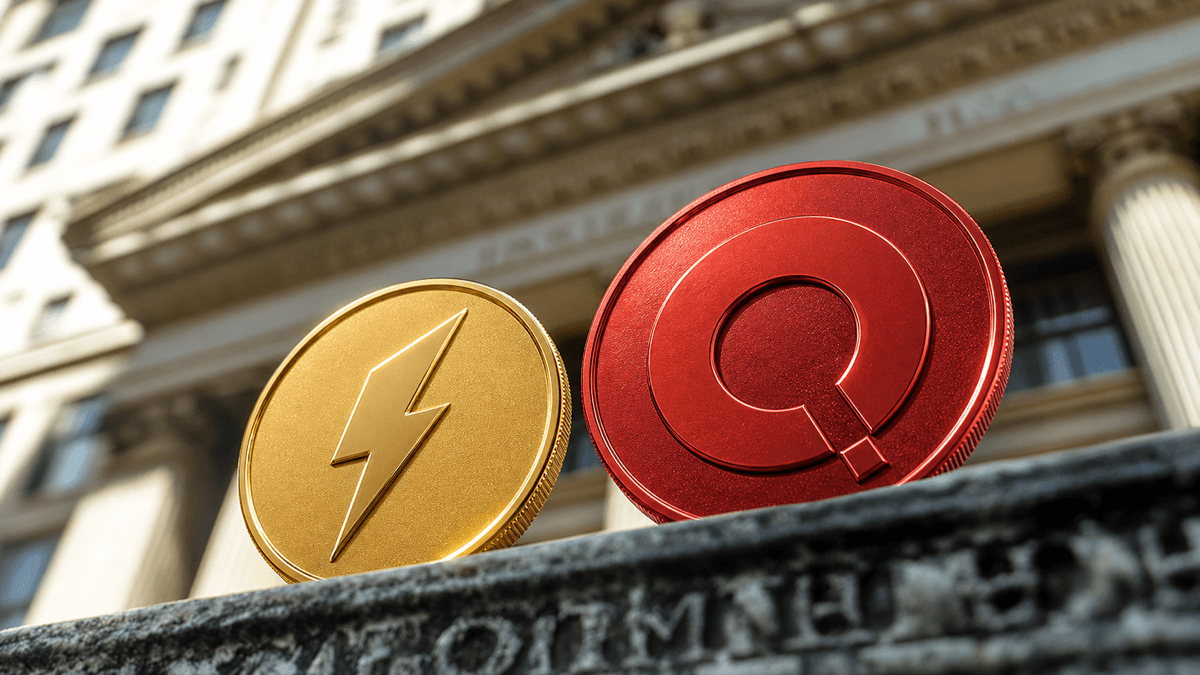
Quai was built as energy-based money in two forms. QUAI is digital oil, a mined commodity that fuels smart contracts and powers the network's programmable economy. QI is a decentralized energy dollar whose value is anchored to the real cost of the energy that produces it. Both are secured by proof of work, the foundation the bill treats most favorably.
What the crypto CLARITY Act says
The current Senate framework creates a category for native blockchain assets called network tokens. Qualifying tokens would be recognized as digital commodities, and that shift matters as much for perception as for law. It treats a native network asset as its own kind of thing, defined by the network that produces it.
The Senate text also matters for proof-of-work networks. Mining, validating transactions, operating a node, publishing open-source software, and providing noncustodial tools would not, by themselves, make someone a regulated financial intermediary.
Why proof of work supports commodity treatment
A decentralized network is run by its community. Miners spend real energy to secure it, node operators enforce its rules, developers propose changes, and every participant is free to accept or reject them. Nobody sits at the center. That openness is the whole point.
Commodities work the same way. Gold, oil, and wheat are valued for what they are and what they can do, and they trade freely because no single party stands behind them. An asset that is mined into existence and consumed for use fits that understanding naturally, and it is the treatment that lets open networks stay open.
Proof of work is the strongest foundation an asset can have on that side of the line. A mined token enters circulation the way extracted commodities do, through work and energy expended under open rules. That reasoning is why the CFTC has treated Bitcoin as a commodity for more than a decade. The framework focuses on how tokens enter circulation and who controls the protocol.
How QUAI and QI fit the CLARITY framework
Quai answers those questions on-chain.
- Proof-of-work issuance. QUAI and QI enter circulation through measurable computational work under public consensus rules. QI launched with zero initial supply and exists only through mining or conversion from QUAI.
- Permissionless validation. Anyone can run the software, verify the chain, and choose which consensus rules to accept.
- No unilateral control. Developers can publish an upgrade, but it only takes effect when miners and node operators choose to run it. The network decides. That is the same model Bitcoin proved.
- Protocol-defined rewards. Issuance and mining rewards are set by consensus rules that every participant can verify, not handed out at any company's discretion.
- A supply anyone can audit. As of July 20, 2026, the Quai Supply Tracker reported about 1.041 billion circulating QUAI and 248,912 circulating QI.
All of it is live on the network today, open to anyone who wants to mine or participate.
QI as an alternative to stablecoins
QI was designed for the role stablecoins fill today. It provides a stable unit for payments without depending on a centralized issuer, bank reserves, or a promise to redeem each token for one U.S. dollar.
The design is closer to a flatcoin. QI aims to preserve purchasing power by anchoring value to the energy cost of production. QI launched with zero initial supply, and new QI enters circulation through proof-of-work mining or conversion from QUAI under public protocol rules.
That structure gives QI a different profile from conventional payment stablecoins under the CLARITY framework. Stablecoins depend on an issuer and its reserves. QI is produced by an open network as a native token. Clearer digital commodity rules could give exchanges, payment providers, and users a path to support QI as a decentralized alternative to issuer-backed stablecoins.
What CLARITY could mean for Quai
Legislation cannot alter what QUAI or QI are at the protocol level, and Quai does not need any government's permission to keep operating. What a commodity framework could change is how confidently U.S. exchanges, custodians, market makers, miners, and developers build around the network. Clear rules reward the networks that can prove their facts, and everything that defines Quai, from its code to its supply, is public and independently verifiable.
The bill itself is moving but unfinished. The House passed H.R. 3633 in 2025, the Senate Banking and Agriculture committees have each advanced their pieces of the framework, and reports on July 21 said the White House had agreed on ethics language addressing one of the last major disputes. A floor vote, reconciliation with the House, and a presidential signature all remain. The final text and timing are still uncertain.
Quai was built like a commodity from the beginning. It is issued by work, validated by anyone, controlled by the miners and node operators who secure it, and audited in public. If CLARITY becomes law, it will describe networks like this one. If it stalls, nothing about Quai changes. The future of money is energy-based, grounded in real work and anchored to real cost. Quai is already running.
Sources
- H.R. 3633 status and House vote, Congress.gov
- Senate-reported H.R. 3633 text, June 1, 2026, GovInfo
- Senate Banking Committee vote, May 14, 2026
- Senate Agriculture Committee Digital Commodity Intermediaries Act
- Reported July 21 ethics-language development, Decrypt
- Quai Supply Tracker
- Quai emissions and post-Singularity supply, Quai documentation
- QI activation and zero-initial-supply launch, Quai Network
- go-quai source code and release tags, GitHub
About Quai Network
Quai Network is an energy-based monetary system built on a scalable, programmable Proof-of-Work blockchain. Through innovative Proof-of-Entropy-Minima consensus and merged mining capabilities, the network achieves 50,000+ transactions per second, unprecedented chain revenue, and increased decentralization and security. The network's unique dual-token system combines UTXO-based QI for daily transactions with EVM-compatible QUAI for long-term value storage, creating a comprehensive solution for the future of decentralized finance.
Join us to build a better blockchain
Disclaimer
This article is for informational purposes only and does not constitute legal, financial, or investment advice.
Opinions, ideas, and statements shared in this update are delivered with numerous assumptions, risks, and uncertainties which are subject to change over time. There are multiple risk factors, including those related to blockchain, cryptographic systems, and technologies generally, as well as Quai's business, operations and results of operations, that could cause actual results or developments anticipated not to be realized or, even if substantially realized, to fail to achieve any or all of the benefits that could be expected therefrom. We reserve the right to unilaterally, completely, or partially change plans, expectations, and intentions stated herein at any time and for any reason, in our sole and absolute discretion, and we undertake no obligation to update publicly or revise any forward-looking statement, whether as a result of new information, future developments, or otherwise. ACCORDINGLY, WE RECOMMEND THAT YOU DO NOT RELY ON, AND DO NOT MAKE ANY FINANCIAL DECISION OR INVESTMENT BASED ON, THE STATEMENTS CONTAINED IN THIS UPDATE OR ANY OF OUR UPDATES/ARTICLES — INCLUDING BUT NOT LIMITED TO ANY SELLING OR TRADING OF QUAI TOKENS, ETHER, OR ANY OTHER CRYPTOGRAPHIC OR BLOCKCHAIN TOKEN, OR THE SECURITIES OF ANY COMPANY.
The views, opinions, and statements made in this update are those of an individual author and not those of any institution, University, or legal entity operating within the jurisdiction of The United States or beyond. There is no association between these views, opinions, and statements and any for-profit or non-profit entity, particularly with Universities, Foundations, and other Agencies located within the United States. Any perception of such an association is purely accidental, and will be rectified immediately if brought to our attention by the reader.